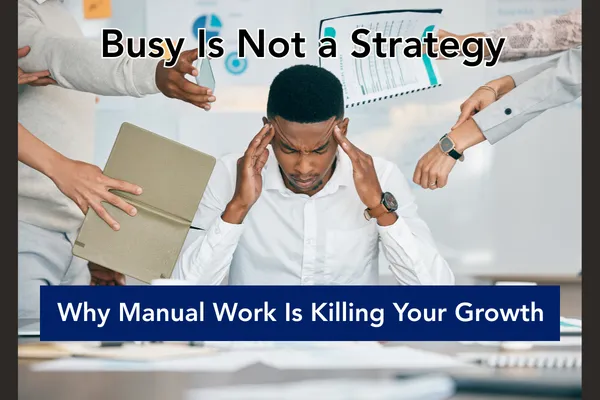
Busy Is Not A Strategy

Busy Is Not a Strategy: Why Manual Work Is Killing Your Growth
If you’re exhausted at the end of every day but still feel like nothing important moved forward, here’s the hard truth:
You’re not overwhelmed. You’re overworked by systems that don’t scale.
Most small business owners don’t fail because they’re lazy or unmotivated. They fail because they’re trapped in manual work that creates the illusion of progress — what I call fake productivity.
Let’s break it down.
The Illusion of Productivity: Why Being Busy Feels Like Progress
It's not a lack of things to do, right?
Answering emails.
Returning calls.
Posting on social media.
Following up with leads “when you get a chance.”
Manually booking appointments.
Trying to remember who needs what.
You’re busy all day — but your business still isn’t building enough momentum.
Being Busy Does Not Equal Productivity
Being busy eats up all your time and energy with little return. However, being productive means:
Leads are followed up without you
Appointments get booked automatically
Marketing runs even when you’re offline
No opportunity falls through the cracks
If everything depends on you remembering, you responding, or you being available, your business is capped. Why? Because as human beings we all have limits. Truth is, there is no way you can outwork or out produce another competitor who is utilizing Ai systems intelligently.
The Real Cost of Running Your Business Manually
Running your business manually doesn’t just slow you down — it quietly taxes every part of your operation. These costs don’t show up as a line item on your balance sheet, but they absolutely hit your revenue, energy, and growth.
Manual systems don’t just waste time — they quietly drain your efforts, time and your revenue. Let’s break down exactly where manual processes are costing you the most.
1. Manual Follow-Ups Is Killing Sales
Manual follow-up is one of the biggest revenue leaks in small business. If you've been running your business for any significant length of time, you know for a fact that leads don’t respond immediately. Not at all! They need:
Speed in response and easy access to information
Consistency over time
Multiple touch points that speak directly to them
When follow-up relies on memory or sticky notes, leads go cold fast. Trying to consistently stay on top of your growing list of contacts inevitably leads to lost leads. The larger your list grows, the greater the number of lost leads, missed opportunities when you are struggling to stay on top with each one.
A common scenario occurs when a lead comes in after hours. They don't hear back until the next day and by then, the've already moved on to something or someone else. This isn't because you don't care, it's because manual follow-up doesn't scale!
Studies show most sales require 5–7 follow-ups — most business owners stop at 1 or 2.
That’s not a motivation problem. That’s a systems problem.
2. Manual Scheduling Creates Friction
Manual scheduling feels normal — until you realize how many customers never complete the process. If a customer has to:
Wait for a response
Go back and forth on availability
Call during business hours
They often won’t bother. Less than 18% of callers will actually leave a voicemail. Instead, they will look elsewhere to get their questions answered. Look, people only take action when motivation is high. A delayed response only serves to reduce urgency. Even a few hours can totally kill momentum. The old adage, "strike while the iron is hot", is very ap pro po in business.
Ai Agent picks up incoming calls on the second ring, removes friction, responds to questions and captures demand in the moment, not later.
Every lead is contacted immediately
Follow-ups happen even if you’re busy
No opportunity is forgotten
If you rely on memory, you rely on luck. Businesses that automate follow-up rely on systems — and systems close more deals. If someone wants to book now and you cannot respond to then now, you will lose them. Manual scheduling often turns high interest into cold leads. How many of them are you willing to let slip by?
3. Manual Posting = Inconsistent Social Media Marketing
Posting “when you have time” is not an effective social media strategy. A large number of small business owners post when thhey remember to, or when things slow down. That creates gaps. Algorithms punish gaps. Customers forget brands that disappear. That results in:
Inconsistent visibility
Weak brand trust
Algorithms working against you
Inconsistency in your social media posts and activity creates gaps. Alogorithms punish gaps in consistency and customers forget brands that disappear. This reduces your efforts to reach people, dilutes your brand influence, lowers trust and results in fewer inbound leads.
By contrast, consistency builds familiarity which then builds trust and credibility in your brand. Trust builds sales. Automation to schedule your social posts, and respond to DM's and post comments lets you:
Schedule content weeks ahead of time
Stay visible daily
Show up even on your busiest weeks
Consistency beats effort every time. Automated posting keeps you visible and predictable...two things customers crave.
4. Manual Lead Tracking Causes Leaks You Can’t See
Spreadsheets. Notes. Multiple inboxes. DMs everywhere. If your leads are living in email boxes, phone contacts, DMs, sticky notes or spreadsheets, you don't have a system...you have chaos. That chaos results in missed follow-ups, forgotten conversations, and no clear pipeline visibility.
If you can’t instantly answer:
Who contacted you?
Where they came from?
What they are looking for?
Who followed up?
Who didn’t?
You’re losing money — you just don’t see it yet. Frankly, you can't improve what you cannot see.
Manual tracking hides problems. Automation exposes and fixes them. This is why CRM automation for small business is no longer optional. A centralized CRM system:
Stores every conversation
Tracks lead activity
Instantly identifies lead temperature (hot, warm or cold)
Keeps leads moving through the pipeline automatically
Prevents leads from slipping through the cracks
Why You Feel Productive But Still Fall Behind
Here’s the uncomfortable truth: Manual work rewards effort, not results. It steals from you.
Taking up your time, energy, opportunities and growth potential. And the worst part? You don’t realize how much they’re costing you until you step away from them.
You feel accomplished because you’re doing, but the work isn’t compounding. When everything is manual you are wearing many hats. In essence you are the follow-up system, the reminder system, the scheduler, and the marketer. There is no safety net under you. That's not a business ownership, that's a self-employment with extra stress on top.
Resulting in long-term damage with no room to scale, burnout becomes a normal and growth feels impossible. Automation gives you leverage. It allows one action to create multiple results. Without leverage, effort never compounds.
Automation creates leverage.
Manual work creates burnout.

Automation Isn’t About Replacing You — It’s About Freeing You!
Let’s clear up a myth.
❌ Automation is not “cold,” “lazy,” or “impersonal.”
✅ Automation is how modern businesses protect time, multiply their productivity, broaden their reach and scale trust.
What Small Business Automation Actually Does
Instantly responds to new leads
Follows up via SMS, email, or voicemail drops
Books appointments automatically
Tracks every conversation in one place
Nurtures leads while you focus on revenue
This is how you stop doing everything yourself without losing control.
Common Questions Business Owners Are Asking
“Why am I always busy but not growing my business?”
Because your effort isn’t compounding. Growth requires systems that work without constant input.
“What business tasks should I automate first?”
Start with:
Lead follow-up
Appointment scheduling
Review requests
Basic email & SMS nurturing
These create immediate ROI.
“Is automation expensive or complicated?”
No — running your business manually is what’s expensive.
Automation replaces:
Missed opportunities
Lost leads
Burnout
Inconsistent marketing
“Can automation work for small businesses?”
Small businesses benefit more than large ones because time is their scarcest asset.
The Key Takeaway: Momentum Beats Hustle
Being busy feels safe but the real question is, is it productive? Evidence of that productivity is in the number of sales, closed deals. It's in your ROI. Period.
Automation may feel uncomfortable at first. But here’s the difference:
Busy keeps you stuck.
Automation builds momentum.
Momentum builds businesses.
If your business only moves forward when you push it, it’s time to change the system — not work harder.

Final Thought
If you’re tired of feeling productive but falling behind, the problem isn’t your work ethic. It’s the way your business is built.
Build leverage. Build systems. Build momentum.
That’s how you finally get ahead. Visit realleadsfinder.com to get started today.


